

Working the exception register
Asking the Auditor is the conversation. This is the other half: the checks run every night whether anyone asks or not, and what they find waits for you in one place. Open Audit in the left rail.The one sentence that explains the whole screen.
An exception is not a message you dismiss.
It is a row that stays until the book changes, and every night it is still wrong it gets one day older.The page says it in its own words at the top: “One row per exception, not per sighting.”
What you are looking at
The Audit desk has five tabs.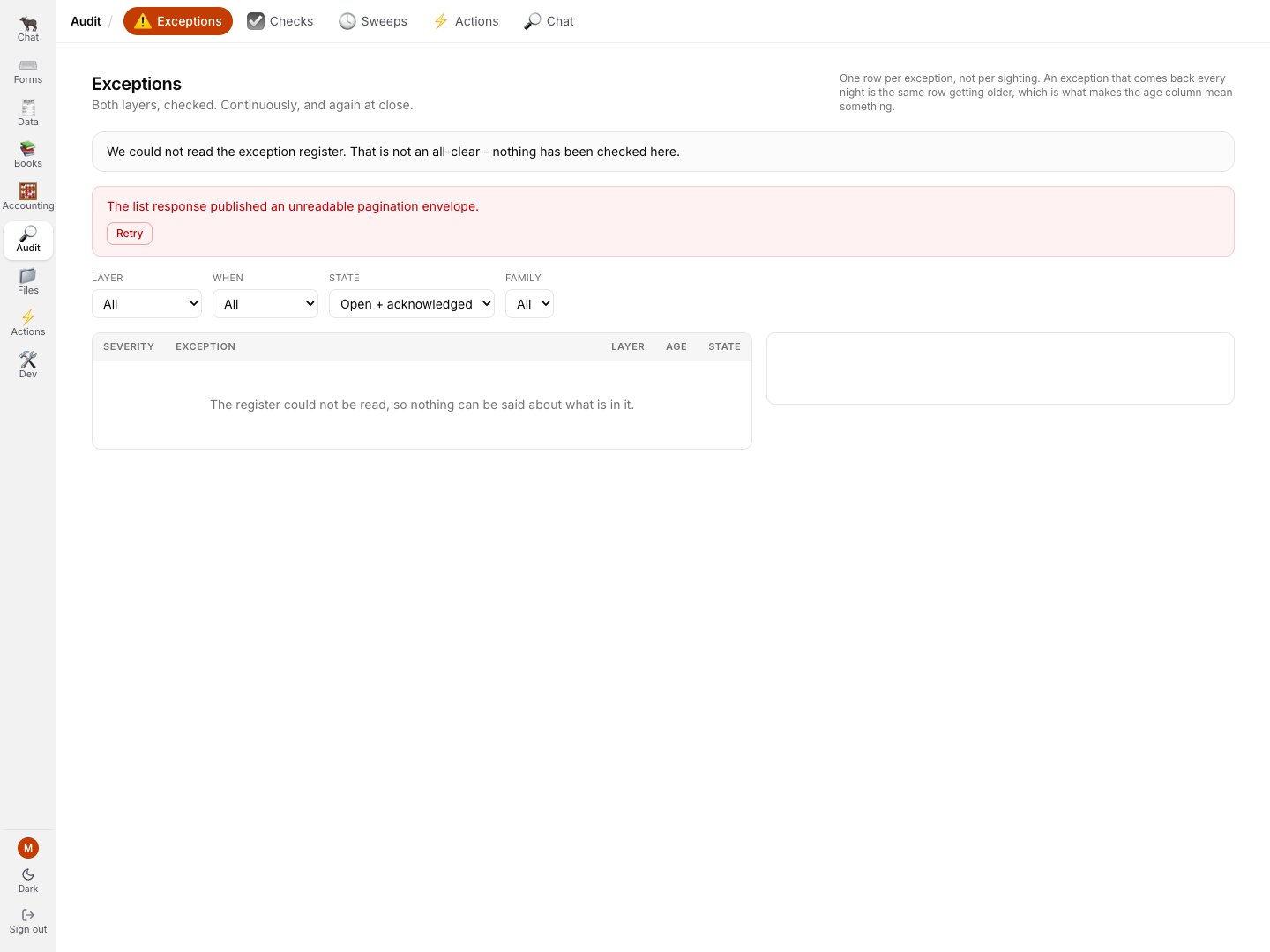
The current credential-free demo publishes an unreadable envelope. The register says nothing was checked instead of presenting an empty all-clear.
Audit → Actions carries the subset a person can act on, split into the bookkeeping lane (find the missing or wrong document) and the accounting lane (decide what this belongs to).
You only need to read your own lane.
Reading a finding
A row tells you five things, and each one is there because a chat answer could not give it to you.
Click a row and the panel on the right gives you the whole finding.
Three things in that panel are worth pointing at.
The message tells you what to do, and what not to.
“The entry is immutable, so the remedy is to attach the supporting document, not to correct the posting.”
A finding that named a problem without naming its remedy would send people to the wrong screen.
“What the check recorded” is the raw fields the rule keyed on, so you can tell a real exception from a mis-keyed one without reading any code.
The line under the buttons is the rule this whole system rests on:
“Acknowledging says you have seen it; it stays an open exception. Nothing on this screen can mark an exception resolved - only a sweep that re-reads the book and does not find it again may do that.”
Running a check on demand
You do not have to wait for tonight. Audit → Sweeps is both halves: what is scheduled, and what has actually run. Each job is designed to describe both its scope and its exclusions.nightly close continuous runs the 54 must-be-zero continuous checks plus the 22 reported balances and does not run the 26 close-gated ones, which only make sense after a period-end procedure and would false-flag every night.
A job that told you only what it covers would let you assume the rest.
Then read a run, not just its verdict.
The two badges are two different facts, and this is the most important habit on the page:
A run can be clean and incomplete at the same time.
What it did NOT verify is printed as its own section rather than left as an absence, and what it covered states the window the run answers for.
A clean verdict over a narrow scope is not a clean book, and the run tells you which one you are looking at.
You can also just ask in chat: “Run a full check on the books” runs the six routine families and narrates one line per family.
The seventh,
close_gated, has a runner but is explicit-only: name it or schedule it for the appropriate close period.
The three things you can do with a finding
Acknowledge
“Seen, and being handled.”
Use it so the rest of the team knows somebody has it.
It does not claim the problem is gone, and a re-sighting does not undo it.
Waive
“I know, and it is not going to change by .”
Needs a reason and an expiry.
The control comes back on by itself.
Fix the book
The only thing that actually makes an exception go away.
Correct the underlying document or posting, and the next sweep resolves it.
Waiving, and what it costs you
A waiver is the one judgement in the register, and the dialog opens by telling you so.“You are silencing a control, not clearing an exception. It will be recorded against you by name, with your reason, and it re-opens on the date below.”It is bounded in four ways.
1
You must be a person
An agent identity, a placeholder name, and a server-to-server service token are all refused with a 403.
A waiver is a human silencing a control and an unattributable one is worthless.
“a service-token caller cannot waive an audit finding: a waiver is a human silencing a control, and there is no human in a server-to-server request”
2
You must give a reason
Required, and the database refuses a waiver without one rather than trusting the form.
3
You must give an expiry, and it is capped
The default is the end of your fiscal year, and the dialog says where that comes from: “read from your own fiscal calendar by the backend, so it is your year end and not a date this screen guessed”.
You may bring the date forward.
You may not push it past the cap, and if you try you get a refusal that names the limit rather than silently moving your date.
4
It comes back
When the expiry passes, the next sweep re-opens the finding.
Until then it behaves like an acknowledgement: seeing it again does not undo the waiver.
Who waived it, why, and until when stay on the row afterwards.
A waiver never hides anything silently.
Waived findings are excluded from the “is anything wrong?” count, so a waiver genuinely lets a clean claim through.
And every surface that makes such a claim reports the waived count beside it.You will see “clean, with 1 waived exception”, never a bare “clean” over a control somebody switched off.
Closing an action
An exception that a person can act on opens a task in Audit → Actions, in its own lane.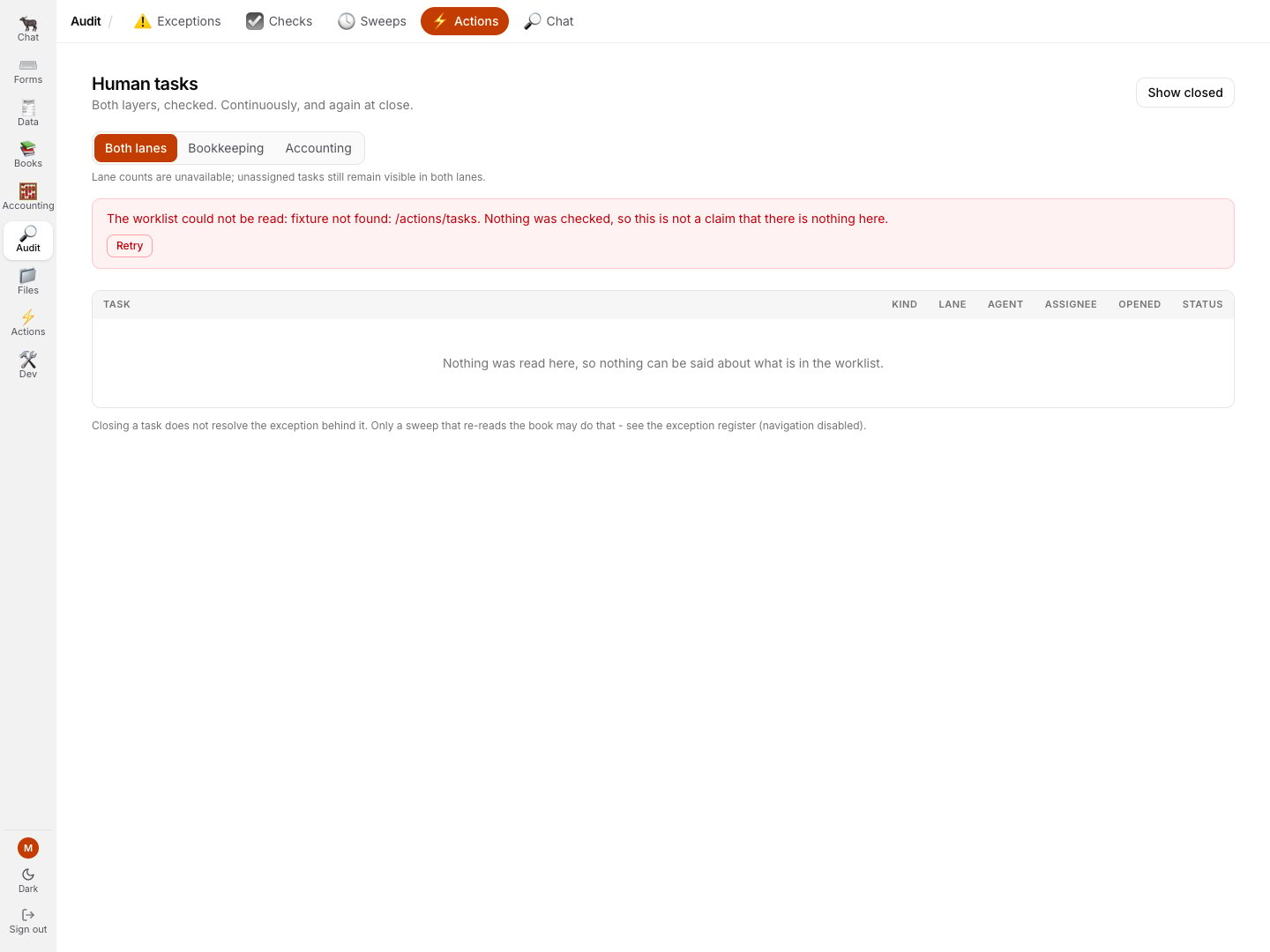
The current Human Tasks demo response is unavailable. Lane totals and queue contents remain unknown instead of becoming zero.
Read the sentence above the table before you trust the lane counts.When open tasks have no lane recorded, the page states how many appear in both and marks each one Both lanes · no lane recorded.
That deliberate over-routing keeps an untagged task visible; the opposite default is how work disappears.
“Closing a task does not resolve the exception behind it. Only a sweep that re-reads the book may do that.”That is not a limitation, it is the point. It is entirely legitimate for the work to be done while the finding stays open until tonight’s sweep confirms it from the book. Every change is stamped with who made it and when. The other direction is automatic: when a sweep does resolve a finding, its task closes in the same breath and says why it vanished, so you never find yourself working a task for a problem that no longer exists.
A worked example
A representative finding from the seeded assurance fixture, in full:warning · Open · Bookkeeping · matching AP-FIX-1 supplier VAT invoice (Alpha) AP-FIX-1 supplier VAT invoice (Alpha) (What each part is telling you:supplier_vat_invoice) is POSTED to the ledger and there is nothing behind it - no uploaded file, no document composed in the Typewriter and no record it was staged into. The entry is immutable, so the remedy is to attach the supporting document, not to correct the posting. CHECK Document completeness ·missing_evidence· WHEN IT RUNS Not stated · SEEN 2 times · ON THE WORKLIST yes
missing_evidenceis one of six completeness rules. When it runs: not stated because this rule has no clock at all: a posted document with nothing behind it is wrong the moment it exists, not wrong for getting old.- Bookkeeping · matching means it lands in the bookkeeping lane. Somebody needs to find the file, not decide an allocation.
- seen 2 times is one row that has been re-sighted, not two alerts.
- On the worklist: yes means there is a task for it in the Bookkeeping lane of Actions.
- There is no resolve button. Attach the evidence, and tonight’s sweep will resolve it for you.
Related
- Asking the Auditor - the conversational half
- The exception system - the same system, in full technical detail
- Two layers on the same documents - what the lane on a finding means
- The Close checksums - the 104 checks, by phase and by layer
- Closing a period - where the close-gated half is asked