

Trusted responses and honest unavailability
GreatBook does not treat a successful HTTP request as trustworthy accounting evidence. Every response used by the finance workspace must resolve to trusted data or to an explicit unavailable reason before the screen can make a claim. The shared rule lives in the GreatBook web repository’ssrc/lib/trusted-response.ts and is consumed across the shipped Typewriter, Review, Settlements, Ledger, Accounting, Audit, Files, Planning, and Actions read paths.
It is the boundary that prevents three particularly dangerous UI failures: inventing a replacement record, hiding an unreadable record, and turning unknown data into an empty or reassuring default.
Refuse only the smallest unsafe scope
Aliases and repeated signals must agree exactly.
For example, two copies of approval evidence do not become stronger by disagreeing: GreatBook quarantines the authorization cluster and makes no approver claim.
Unknown is not empty
Lists accept the server’stotal, count, limit, offset, has_more, and next_offset only when those facts reconcile with the returned records and the requested page.
The browser does not derive a total from the rows it happened to receive, invent a continuation offset, remove a malformed row, or call an unreadable response empty.
When a refresh fails, earlier evidence may remain visible only as retained evidence.
It cannot authorize a mutation or navigation until a current response confirms it again.
Likewise, a mutation’s transport success is not durable acceptance: the UI requires exact request-bound server evidence, and an unknown outcome stays awaiting confirmation.
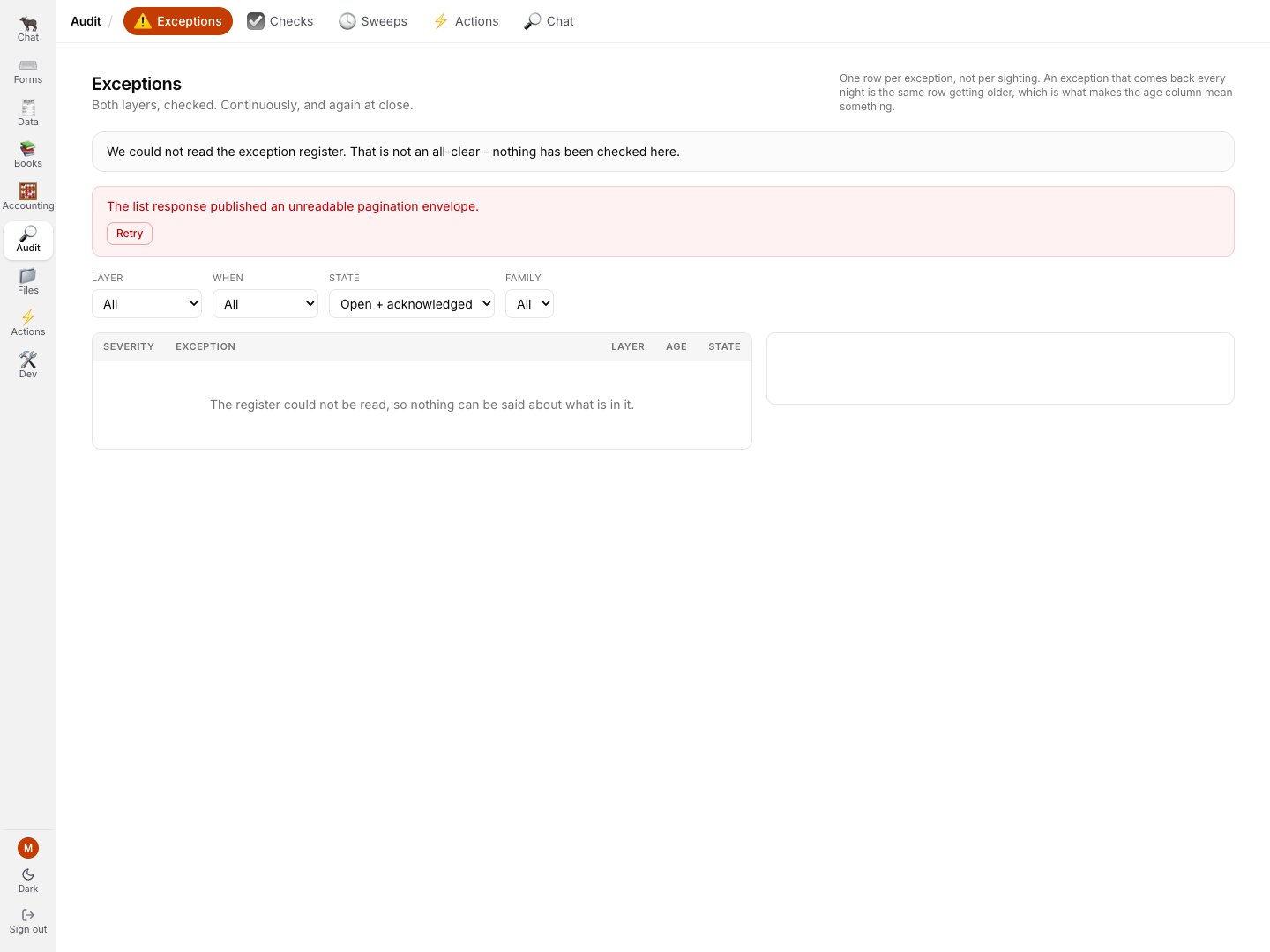
The credential-free demo publishes an unreadable pagination envelope. Audit says the register could not be read and explicitly refuses the all-clear that an empty table would imply.
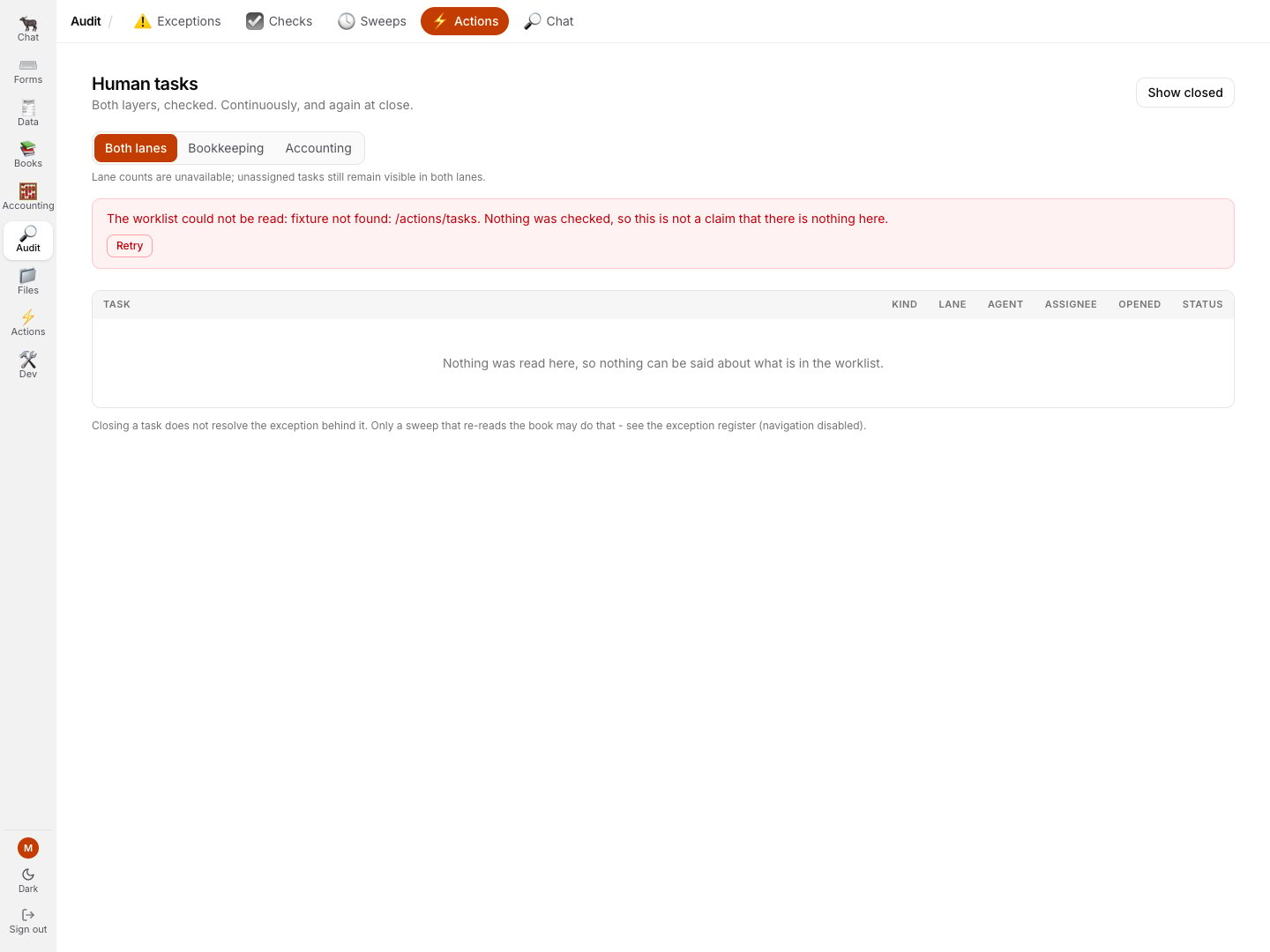
The same rule is scoped independently on the human worklist: lane counts are unavailable, the list makes no empty claim, and the reason remains visible.
Verified at source
- The GreatBook web repository’s
src/lib/trusted-response.tsdefinestrusted,unavailable, the five scopes, exact agreement, row identity preservation, and page-position rules. - Its
docs/crash-safety-check.mdnames the customer-facing list contract and the exact totals and continuation facts each list must preserve. - Merged web PRs
#55–#58apply the boundary to the finance surfaces and canonical settlements. - Merged backend PR
#100makes statements fail closed and publishes server-owned totals and continuation for the paged lists.